
Osceola Property Values Compared
Michigan property records draw a sharp line between three numbers that often get confused. One is the assessed value, which drives assessment administration. Another is the taxable value, the figure the tax roll actually uses. The third is a past sale price, frozen at the moment a deed changed hands. An Osceola County property value lookup turns on telling them apart. Each serves a different purpose.
| Value | Meaning | Official source |
|---|---|---|
| Assessed value | Generally one-half of true cash value under Michigan's assessment level. | Local assessor and Equalization roll. |
| State equalized value | Assessed value after county and state equalization. | Assessment roll. |
| Taxable value | The capped or uncapped base to which millage applies. | Assessment and tax record. |
| Recorded sale price | Consideration tied to a past transfer, when shown. | Deed and possible parcel history. |
| Private appraisal | A date-specific professional opinion for a stated purpose. | Not a county public-record figure. |
Parcel cards do not all use the same field labels. Terms like "market," "true cash," or a land-and-improvement split may appear, or the card may say something else. Read the live result and preserve each label as written rather than assuming a standard format.
Michigan's Osceola Assessment Level
Michigan generally assesses property at 50 percent of true cash value. State equalized value, or SEV, is the assessed figure after equalization. Doubling SEV can hint at the true-cash framework behind it. It is not a guaranteed selling price. County Equalization studies sales. It also appraises property for equalization work, and it helps keep assessments equitable among local units. Local assessors maintain the rolls themselves. Reed City's assessor, for instance, handles the city roll. County Equalization carries out the broader county function.
- True cash value
- Michigan's market-value concept for assessment law.
- Assessed value
- Generally 50 percent of true cash value.
- SEV
- The assessed value after equalization.
- Taxable value
- The separate base used with millage to calculate tax.
Osceola Taxable Value Under Proposal A
Taxable value does not simply shadow every change in assessed value. Proposal A caps its growth at inflation or five percent, whichever is less. Adjustments are made for additions and losses. A qualifying transfer can trigger uncapping under the governing rules. That cap is why two similar parcels can show different taxable values. Principal Residence Exemption status affects the taxes due. But it does not move the market value of the land. Michigan offers a PRE denial and appeal route. The state guidance includes a 35-day appeal window. Those questions belong to the tax record, not to a prediction of sale price. For millage, delinquency, and appeals, turn to Osceola County property tax records. Keep the value itself separate from the amount currently owed.
Look Up Osceola Property Value
Start from a known address. Then carry the parcel number and assessment year through the whole comparison.
- Open the county-linked BS&A property-information route and use Address or Parcel Number.
- Confirm the situs and legal description before copying any value.
- Record assessed value, SEV, taxable value, year, exemption status, and component values only when the live card shows those labels.
- Check a displayed sale date or price against the newest relevant deed in Tyler.
- Ask the local assessor or Equalization about the roll when the parcel, year, or classification seems wrong.
The county's property search lets visitors look up parcels directly. Exact field labels on a value card can vary, though. Treat the live card as the authority on what each figure is called.
Osceola Sale Price Is Historical
A deed's consideration speaks to one transaction. It may reflect special conditions, included interests, family relationships, or terms that weaken a simple comparison. Even a clean arm's-length sale captures a single property at a single moment. Match any sale price to its deed date, recording date, parties, and legal description. The assessment roll may display sale history as well. But rely on those fields only where present. One recorded amount never becomes a current market estimate without further analysis. Nearby sales offer context, yet parcel differences matter. Acreage, buildings, frontage, access, zoning, easements, and condition can vary along the same road. They can also vary within the same plat. The public record is no substitute for an inspection.
Date Every Osceola Value
Every assessment figure belongs to a roll year. A recent deed may appear at any time. It can show up before the roll reflects the new owner. It can also precede any uncapping effect. Osceola County publishes no fixed number of days for sale-to-roll updates. So assume no standard lag. Record four dates whenever they are available. These are valuation year, sale date, deed recording date, and tax year. When two records conflict, dates often explain why. Equalization and the local assessor can clarify the official roll. The Register of Deeds can confirm access to a recorded instrument. A split, combination, or land division can also create a new APN. Follow the legal description when lining up a prior value with a current parcel. Otherwise an apparent swing may simply compare different land.
Local Context for Osceola Values
Plats and municipal records add context without supplying an appraisal. Evart records identify Snyder's Addition, Old Town material, and the Evart Air Industrial Park. Reed City records name Holden's Addition, J.M. Reed & Go's Addition, and Bittner's 2nd Addition. Zoning and permit files document authorized use or work. Evart's 2026 materials cover zoning permits, site plans, special land use, rezoning, and variance fees. Reed City's permit forms ask for owner, parcel, project type, district, dimensions, and setbacks. Such records can explain why nearby parcels differ. But a permit proves neither completed work nor value. A postal city can cross a municipal boundary. Confirm whether a parcel sits in a city, village, or township. Do that before reaching for a zoning record or comparing tax treatment.
Historic Osceola Value Clues
Old Osceola tax rolls hold real clues. The Archives of Michigan holds county tax-roll runs beginning in 1869. Those rolls stretch onward into 2006. They can sketch a taxpayer chronology or separate owners in eras before street addresses settled, though they say nothing about title and translate poorly into today's dollars. Maps help too. The Library of Michigan county guide catalogs a 1900 plat book and later map resources. Those are handy for tracing an old parcel name or a geographic change. Once the geography makes sense, return to modern assessment and deed records for facts that stand today.
What Osceola Property Value Is Not
An assessed value is a mass-assessment figure built for public administration, not a private appraisal. It is not a home inspection. It is not a boundary survey or title opinion. Taxable value is not market value, and a prior sale price predicts nothing. For a dated opinion, hire a qualified appraiser. Doubling a number or copying an automated estimate replaces neither that appraisal nor the assessor's explanation of the public roll and its appeal process.
Value versus price. No Osceola County record guarantees what a buyer will pay. Compare dated records and seek a qualified appraisal when current market value matters.
Use Osceola County property search for broader parcel mechanics and the official record links.
Osceola's Value Search Gateway
The county-linked BS&A gateway is the official start captured during research.
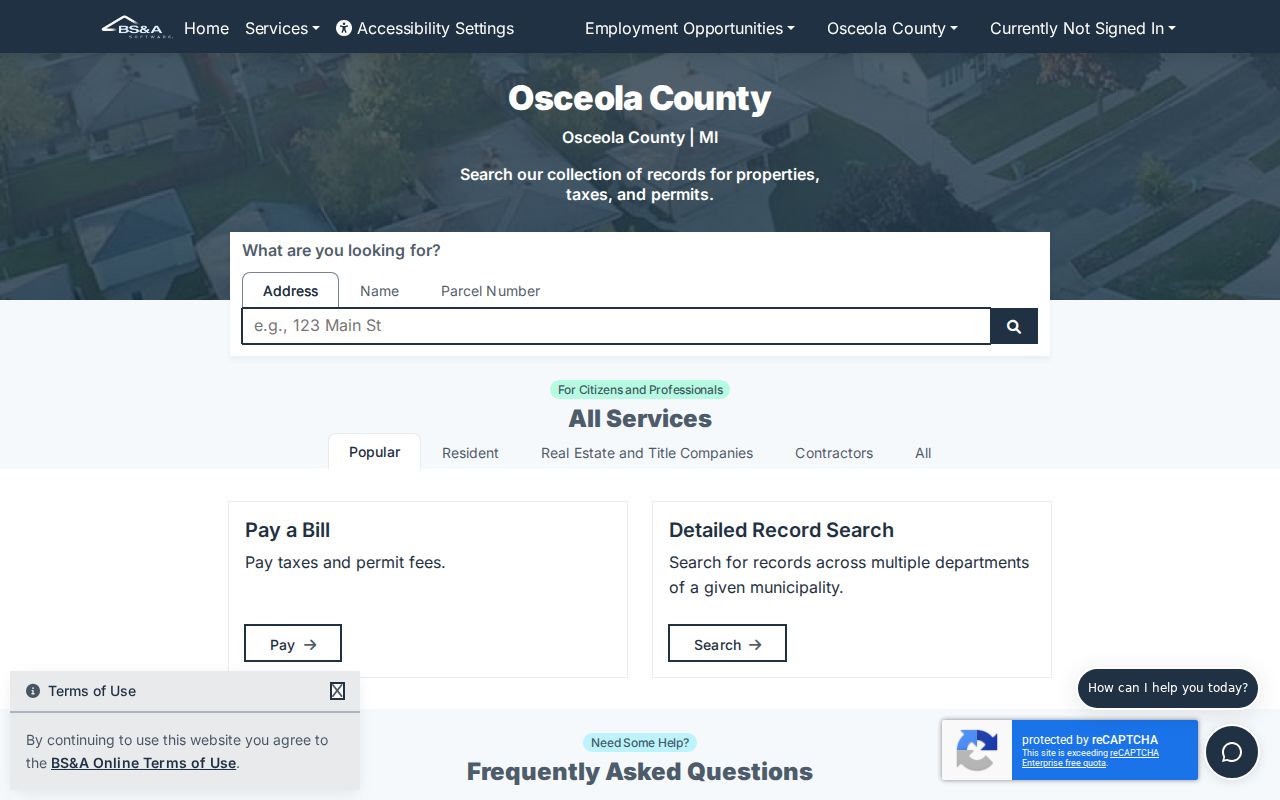
The image documents access without claiming that an individual parcel's value fields were visible.
Question an Osceola Assessment
A surprising Osceola assessment deserves a close look. Start by confirming identity and year. Check the parcel, classification, situs, legal description, additions or losses, transfer date, and exemption status on the notice. Ask the local assessor for the roll record. The equalization office can explain its countywide role. If a Principal Residence Exemption is denied, Michigan Treasury's 35-day appeal route is the right path, not evidence that market value must be wrong. Keep your evidence dated, because a deed, survey, photographs, appraisal, and comparable sales each answer different questions, then follow the official notice and appeal instructions for that parcel and year.
Compare Osceola Value Components
When a live card separates land and improvement values, copy both figures along with the year. Not every card shows a split. The split is not a repair estimate. Classification, acreage, structures, and additions may explain an assessment change, but report only the fields the official record actually displays. Compare like years and like parcels. A land division can make two records look inconsistent when acreage differs, so follow the legal description across any APN change before calculating a trend.