
Inside Osceola Tax Records
Osceola County property tax records live in two places. The assessment roll comes from one side; the tax account from another. County Equalization verifies sales and performs appraisals. It also maintains the property information behind the assessment and tax rolls. It works with local assessors to keep values equitable countywide. The Treasurer holds county money and pursues delinquent collections. That office also handles foreclosure work, deferment forms, and surplus-proceeds claims. Current collection often stays with a city or township treasurer. That split matters more than it seems. The value source, the current bill source, and the delinquent balance source can all be different offices.
| Field | What It Shows | Where |
|---|---|---|
| Assessed value and SEV | The statutory value tied to true cash value | Assessment roll and BS&A |
| Taxable value | The capped or uncapped base used with millage | Assessment and tax record |
| PRE or other status | An exemption or classification flag affecting the bill | Local assessor and state forms |
| Current tax status | Charges and payments for a current collection year | Correct city or township treasurer |
| Delinquent balance | Returned taxes, interest, fees, and foreclosure stage | Osceola County Treasurer |
A tax bill is not a sale appraisal. Michigan generally sets assessed value and state equalized value at 50 percent of true cash value. Taxable value is a different animal. Proposal A rules govern it. A recorded sale may trigger uncapping in the next assessment cycle. Even so, the consideration on a deed is one transaction, not a standing statement of what the parcel is worth today.
Osceola Equalization and Assessors
The Osceola County Equalization Department connects the public to property information and the county GIS. It handles sales verification, appraisal, roll maintenance, and countywide equity. Parcel-level assessment decisions still rest with local assessors. Those assessors maintain their own units' rolls. Questions about classification, an exemption, or an assessment notice should start there. County Equalization, meanwhile, can explain how the countywide system fits together.
The county-linked property information route runs through BS&A. The municipal search page offers Address, Name, and Parcel Number modes. It also includes Assessing Search, Detailed Record Search, and Current Tax Search. The county endpoint sits behind a JavaScript access gate. So read the live card as presented. Do not assume a general Name field is the legal owner of record field.
| Search key | Best use |
|---|---|
| Address | Start with a known situs, or physical property, address |
| Name | Find records indexed to a person or entity as the system displays them |
| Parcel number | Reach one tax parcel while avoiding similar street addresses |
Note: Copy the parcel number exactly, with hyphens, leading zeroes, and suffixes, since Osceola publishes no official formatting rule.
Osceola Values Under Proposal A
The Michigan property-tax guide draws a clear line between assessed and taxable value. Assessed value is generally 50 percent of true cash value. State equalized value, usually shown as SEV, reflects equalization of that assessment. Taxable value is the base. Multiply it by authorized millage and you get the tax. Proposal A caps annual taxable-value growth, apart from additions and losses. A transfer then uncaps it under state rules.
Two similar Osceola County parcels can carry close assessed values. Their taxable values may still differ widely. Transfer histories, additions, losses, and exemption status all diverge. The county's tax calculation sheet lays out how assessed value, taxable value, market context, and mills relate. One mill means one dollar of tax per thousand dollars of taxable value.
- Assessed value
- The assessor's statutory value, generally half of true cash value in Michigan.
- Taxable value
- The Proposal A base to which authorized mills are applied.
- Mill
- A tax rate unit equal to one dollar per thousand dollars of taxable value.
- PRE
- The Principal Residence Exemption status for an eligible principal residence.
- Tax lien
- A claim tied to unpaid property taxes, distinct from the parcel's market worth.
Osceola Current and Delinquent Taxes
Who collects depends on the taxing unit. The Osceola County Treasurer notes that current summer taxes for Evart, Hartwick, Hersey, and Osceola Township run through the BS&A route. Other townships send current payments to their own township treasurer. Identify the parcel's municipality or township first. Otherwise a single result may not be the whole current account.
Unpaid taxes that come back delinquent shift to the county Treasurer. Its page links a BS&A delinquent-tax search, hardship-extension materials, foreclosure information, and surplus-proceeds forms. The office sits at 301 W. Upton Avenue in Reed City, reachable at 231-832-6107, open Monday through Friday from 8:30 a.m. to 5 p.m. Those phone and counter routes earn their keep when an online balance lacks context or a payment has not yet posted.
Note: A current township bill and a county delinquent account answer different questions, so check the tax year and collecting office on every result.
Look Up an Osceola Tax Bill
Begin with the county's official tax and property links. Never start from an unlabeled copy of a bill. Keep the parcel number, taxing unit, and tax year together in one place. Searching by address is convenient. A parcel key is cleaner, though, when road names or postal cities overlap. If the portal is down, call or visit the responsible treasurer. Ask for the same year-specific status.
- Find the parcel in the county-linked BS&A route by address or exact parcel number.
- Confirm the municipality or township and decide whether the current collector is local or county.
- Read the tax year, taxable value, mills, charges, payments, and stated balance as separate fields.
- For returned taxes, use the Treasurer's delinquent search and ask about any notice, forfeiture, or redemption stage.
- Situs address
- The parcel's physical location, which may differ from the owner's mailing address.
- Parcel number
- The local identifier used to connect assessment, tax, GIS, and deed research.
- Tax year
- The levy period to which a charge, payment, or delinquency belongs.
- Redemption
- Payment within the lawful foreclosure period to keep the property from being lost.
Osceola PRE Status and Exemptions
An exemption flag changes tax treatment, not the parcel's boundary or its recorded ownership. Michigan's Principal Residence Exemption applies to an eligible principal residence. Agricultural and other classifications follow their own forms and proof rules. Read the live assessment record for the status shown. Corrections and supporting documents then go through the local assessor.
A PRE denial has its own route. The Michigan Treasury PRE appeal page describes a 35-day window after the denial notice. The issuer of the denial matters. A local assessor may handle the appeal. So may the county. The notice itself names the correct Treasury path. Keep the notice, parcel identification, occupancy evidence, and filing proof together.
The official state page sets out that appeal path and its timing.
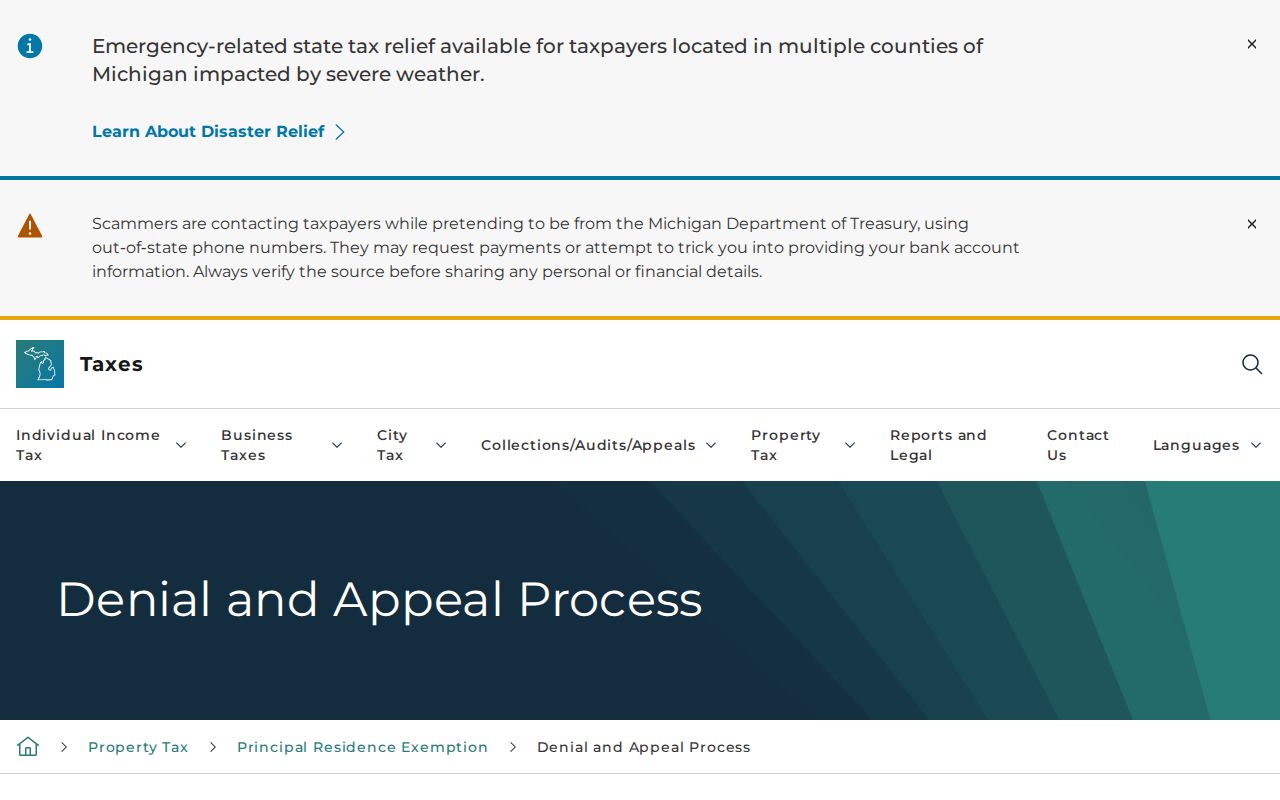
Treat the screenshot as an entry point only. The dated denial notice is the document that names the office and deadline governing an Osceola County parcel.
Osceola Delinquency Becomes Foreclosure
Michigan runs delinquent property taxes through a three-year sequence under MCL 211.78a through 211.78m. The Michigan Treasury foreclosure process begins with levy and return of unpaid taxes in year one. Year two brings forfeiture and expanded notice work. Year three carries judicial foreclosure, redemption deadlines, and auctions. Confirm exact calendar dates against the current state timeline.
Read Osceola County property tax records by stage, not in one glance. A balance is not forfeiture. Forfeiture is not a finished foreclosure deed. Note the tax year, notice date, certificate or judgment status, redemption deadline, and parcel description separately. The Treasurer also posts a hardship-extension form and post-sale surplus-proceeds claim materials. Those forms address relief or proceeds. They do not prove current ownership.
Time matters. Contact the Osceola County Treasurer at once when a record shows forfeiture or foreclosure, because the current official notice controls redemption rights.
When Osceola Tax Cards Lag
The annual assessment roll and a newly recorded deed move on different clocks. Osceola County publishes no official count of days between recording and a BS& update. A fresh transfer can show up in the Register of Deeds index first, while the tax or assessment card still carries older details. Compare record dates rather than guessing at a standard delay.
The Treasurer page identifies the county's delinquent-tax route and local tax responsibilities.

Use the county route for delinquency questions. When ownership is the real issue, consult the latest recorded deed instead of the tax account.
Contest an Osceola Assessment
A parcel-value dispute begins with the assessment notice and the assessor named for that unit. Check the parcel description, classification, assessed value, taxable value, exemptions, and effective year. Good evidence includes accurate property characteristics. A survey or corrected legal description helps where relevant. Comparable sales from the same valuation period also count. County Equalization can explain sales verification and equity. Still, the notice sets the first filing route.
Never substitute a PRE appeal rule for a general valuation appeal. The 35-day state route covers PRE deniations only. A value or classification challenge follows the review and tribunal path. That path is printed on the assessment notice. Keep the notice and proof of timely delivery. If the problem is a tax payment, take it to the collecting treasurer. Not the assessor.
Appeal window. Follow the deadline and office printed on the Osceola assessment or PRE denial notice; different disputes use different review paths.