
Osceola's Owner-of-Record Card
Finding who owns a property in Osceola County takes two checks. The assessment roll shows the working owner display. It also carries the parcel number and where tax notices go. A freshly recorded deed, though, may name a newer grantee before the roll catches up. Keep the situs address apart from the tax mailing address. Match the same legal description across both systems. That simple habit keeps an occupant, a prior taxpayer, or a trustee from being mistaken for the owner of record. Anyone can search Osceola County property records by address. That confirms the name the county itself carries.
| Owner name | Copy the exact label and name shown on the assessment roll. |
|---|---|
| Mailing address | The destination for assessment or tax notices, not proof of residence. |
| Situs address | The physical address assigned to the parcel. |
| Parcel and legal description | The keys used to confirm that both records concern the same land. |
| Last sale date | Use only if the live card displays it, then compare it with the deed date. |
| Deed reference | Use only when shown; open the recorded instrument for confirmation. |
Treat the card as a lead, not proof. County Equalization keeps assessment and tax-roll information current. The Register of Deeds holds the permanent land record.
Check Osceola Roll Labels
Owner, taxpayer, mailing recipient, and occupant are not the same role. Keep each label next to its value. A faraway mailing address may just mean notices go to a business office, a post-office box, a trustee, or a care-of line. It says nothing about who lives at the situs.
- Owner of record
- The party named as owner by the record being consulted.
- Assessment roll
- The public record used for assessed and taxable property administration.
- Situs
- The property's physical location, distinct from its mailing destination.
- Recording lag
- The interval between filing a deed and a later roll update. Osceola publishes no fixed interval.
The county's BS&A entry page shows the access gateway rather than an individual detail card. Open the Osceola property-information entry to see the live labels.
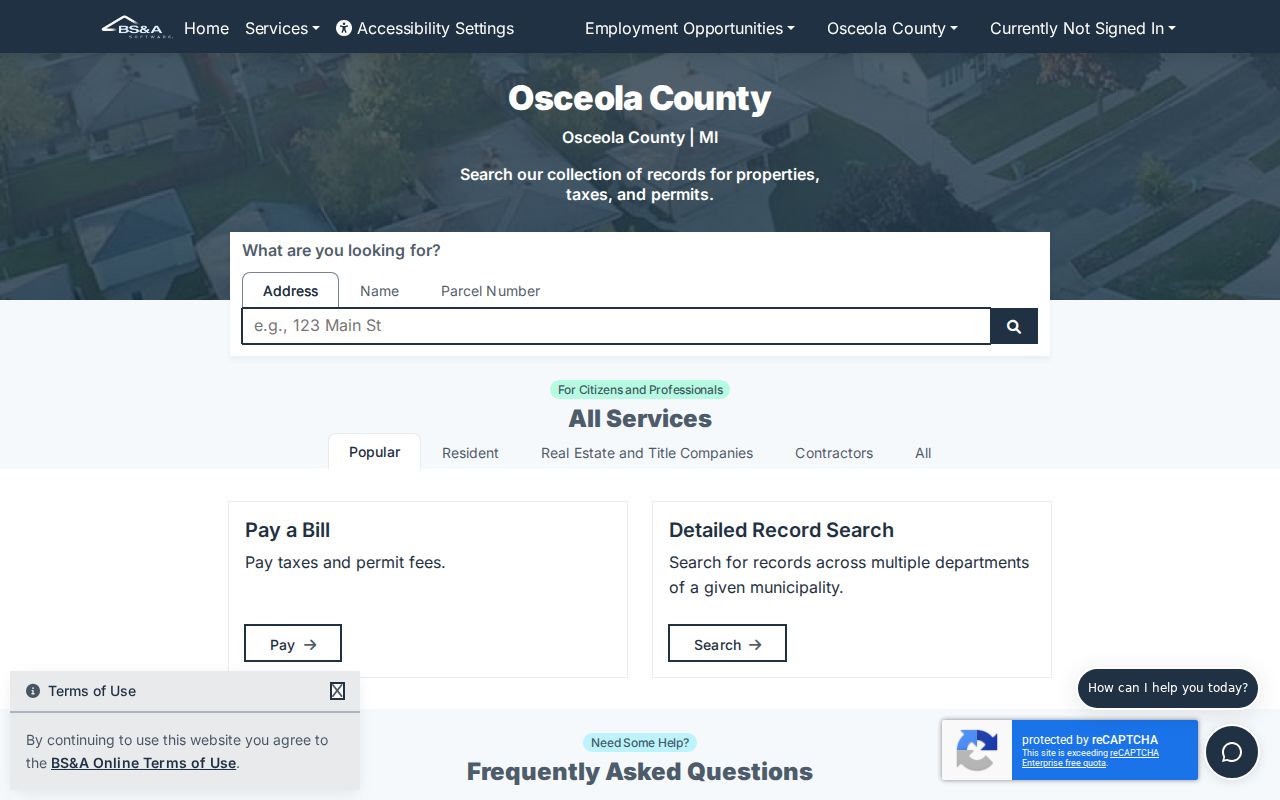
That gateway display has limits. Report only fields the public result actually shows, never a card field you assume exists.
How Fresh Is Osceola Ownership
Osceola County publishes no fixed number of days for a deed recording. An assessment-roll name change follows its own timing. Compare date against date. A deed filed last week may name a grantee. That grantee may not yet appear in BS&A. The roll moves with the annual assessment and tax process. The deed index moves when instruments are filed at the Register of Deeds. Two conflicting names call for three details. These are the assessment year, the deed recording date, and the exact legal description. Claim no standard delay. The newest deed is often the more current transfer record. Even so, an index entry is only a finding aid. The instrument itself must be read.
Recent-sale check. The roll can trail a transfer. Compare the newest recorded deed with the same parcel and legal description before naming the current owner.
Confirm Osceola's Current Owner
Confirmation is a short present-owner check. It does not require reconstructing the older chain.
- Search the parcel by address in BS&A and copy its number, situs, displayed owner label, and mailing line.
- Open the Tyler land-record index and search that name as either party or grantee.
- Favor the newest relevant instrument, then compare its legal description and recording date with the parcel record.
- If the records disagree, contact the Register of Deeds and report both names and dates instead of choosing by assumption.
The Register's public terminals run 9:00 a.m. to 4:45 p.m., and name-index browsing is free there. Phone, email, mail, and a search-request form all work when the web route falls short. The office draws one line: it does not conduct title or mineral searches.
Current Osceola Entity Owners
An LLC, trust, or estate can sit in the owner field legitimately. Search the exact spelling first, then common variations. The suffix or trustee phrase matters. Tyler indexes names as they appear on recorded instruments. Michigan's MiBusiness Registry route can confirm an LLC's filing and registered contact. It cannot prove the company owns the parcel. For an estate, try Osceola Probate and Family Court records. They may name a fiduciary or an open proceeding. A firm conclusion still needs the deed. That means a court order or other instrument tied to the same land. An estate name left on the roll often reflects timing, not permanent status.
Match the Osceola Land
Same-name results come apart through the parcel number and legal description. Keep hyphens and leading zeroes intact, since Osceola publishes no simplified APN format. Compare lot, block, subdivision, section, township, and range exactly as written. The county spans T17N to T20N and R7W to R10W. So public-land-survey calls help with rural parcels. A GIS map can confirm the mapped shape sits where expected. Its lines are for reference only and settle no boundary. Stronger cross-references come from the Register's 2026 legal-description search, Plat/Condo mode, Liber/Page route, and office tract index.
Osceola Protected Owner Addresses
Michigan Safe at Home is a state program. It lets a qualifying participant substitute a designated address for a physical one. So a missing or odd contact line may simply honor a valid privacy rule. Never try to uncover the protected location. Do not piece together property, voter, or other public records. The official Address Confidentiality Program explains the substitute-address and mail-forwarding protection. Ownership and residence stay separate conclusions, and neither licenses unwanted contact.
Limits on Current Owner Claims
Each source has its limits. An assessor result is not a title opinion. A Tyler entry is a catalogue reference, not the full recorded document. A GIS outline is not a legal survey. When the parcel identity and the newest instrument agree, though, these tools together support a well-dated owner-of-record answer. Use public ownership information for lawful ends. Good examples are property research, purchase checks, estate work, boundary questions, and civic review. Never use it to harass, intimidate, or expose a protected person. For the wider method, see who owns an Osceola County property.
Reconcile a Recent Osceola Owner Change
After a sale, the assessment display and the deed index rarely move in step. Osceola County publishes no fixed roll-refresh interval. So don't count days or guess a lag. Instead, log the date you viewed each source. Record the deed's recording date, the grantee, and the assessment year too. Then compare the legal description or parcel number. Only then treat the two records as describing the same land.
If the newest deed and the tax roll disagree, say so plainly. The deed is usually the fresher evidence of transfer. The roll still matters, though, because it carries the tax and mailing context. An estate, a trust, or a land division may call for one more record. A corrected instrument may too. Only then can you state the current owner of record with confidence.
Current Osceola Ownership Is Not Occupancy
An owner's mailing address tells you where tax and assessment notices go. It does not prove anyone lives at the situs address. A trust, an LLC, an estate, a care-of line, or a post-office box can appear in property records. All of it can be perfectly valid wording. Record the label exactly as written. Michigan's business registry can confirm an entity filing, but that is all it can confirm. It does not show that a registered contact personally owns the parcel.
Michigan Safe at Home goes further. It substitutes an official mailing address for a qualifying participant and shields the physical address. A missing or different contact line is no reason to work around that protection. Ownership research should stop at the lawful public record and the recorded land instrument.
The web portal can run short on detail. Try the Register's public terminal or an office request. Name-index browsing is free. The office also provides access to older Liber/Page records alongside the modern index. Give staff the party name. Include the rough recording period and any legal description you already found. Note that the county does not run title or mineral searches. Ask for a defined public record rather than a legal conclusion.
Keep the office response together with your saved portal view. Note when you obtained each one. That small audit trail makes later changes much easier to explain.