
What Osceola Deeds Record
The Osceola County Register of Deeds permanently keeps every instrument affecting real property. A deed conveys an interest in land. Mortgages, discharges, liens, easements, restrictions, and notices sit beside deeds in the same land-record system. Yet each serves a different purpose. Read the instrument type before drawing any ownership conclusion from a filing.
| Instrument | Recorded effect | Useful question |
|---|---|---|
| Warranty deed | Conveys the stated interest with deed warranties. | What sale or transfer vested the grantee? |
| Quitclaim deed | Conveys whatever interest the grantor holds. | Was an interest moved or cleaned up? |
| Fiduciary deed | Documents a transfer by an executor or trustee. | Did an estate or trust transfer land? |
| Tax or foreclosure deed | Records a transfer tied to a statutory proceeding. | What proceeding led to the instrument? |
| Mortgage or release | Creates, assigns, or clears an encumbrance. | Does a later discharge match? |
Recording proves the office accepted and indexed a document. It does not guarantee clear title. Later instruments, court orders, omitted interests, or chain defects can all change the answer.
Search Osceola's Tyler Index
The official Tyler land-record search allows free name browsing once you accept its disclaimer. Online names only reach back to 1988. County land records begin in 1853, so an empty online result does not mean no older deed exists.
| Control | Use | Detail |
|---|---|---|
| Either Party | Find a person or entity on either side. | Broad starting point. |
| Grantor / Grantee | Separate transferor from recipient. | Use for chain work. |
| Recording date | Narrow a common name. | Filing date may differ from signing. |
| Document type | Limit the instrument class. | Search releases separately. |
| Liber / Page | Retrieve a known book reference. | Useful from an older deed. |
| Plat / Condo | Find subdivision records. | Match the recorded name. |
| Legal description | Search land rather than a party. | County pages call this new in 2026. |
Treat the index like a catalogue. Open the deed image itself and confirm the legal description, parties, instrument type, and recording date before relying on it.
Build an Osceola Deed Chain
A chain of title links every instrument that moved the same Osceola County parcel from one owner of record to the next. Begin with the most recent deed you can trust rather than the oldest name floating in a broad result list, and work backward from there.
- Find the parcel in BS&A and copy its legal description and parcel number.
- Search Tyler for the displayed owner as grantee or either party.
- Open the newest relevant deed. Record its grantor, grantee, date, and Liber/Page or instrument reference.
- Search that grantor as a prior grantee, repeating only while the descriptions match.
- Move to the terminal, handwritten index, deed books, or tract route when online coverage ends.
- Grantor
- The party transferring an interest.
- Grantee
- The party receiving it.
- Chain of title
- The linked transfers for the same land.
- Liber and Page
- The book and page citation for an instrument.
Search creatively when a name stalls. Try initials, former surnames, trust wording, and exact business names, because a matching name without a matching land description in the deed records proves nothing.
Osceola Deeds Since 1853
Osceola's deed records offer three useful time depths. Permanent land records date to 1853. Easy online names start in 1988. Handwritten grantor and grantee books run through 2003, an overlap that can resolve spelling or indexing trouble.
A 1995 transfer makes Tyler a sound first stop. An 1895 transaction calls for tract, grantor-grantee, or deed-book work. A 2002 name may appear in both modern and handwritten sources.
The Library of Michigan county guide lists a 1900 plat book plus maps and newspapers. Archives finding aids list historic tax rolls beginning in 1869. These explain old names and places, but the deed remains the transfer record.
Plat names bridge eras. Snyder's Addition in Evart ties to Section 34, T18N, R8W. Reed City records use Holden's Addition, J.M. Reed & Go's Addition, and Bittner's 2nd Addition.
Get Osceola Deed Copies
The Register of Deeds sits at 301 W. Upton Avenue in Reed City. Public terminals run from 9:00 a.m. to 4:45 p.m. Phone, email, mail, and a search-request process are alternatives when the web route falls short. Name browsing stays free.
Office legal-description or tract research costs $50 per hour. The Register does not conduct title or mineral searches. The office publishes no complete current plain-copy and certified-copy fee schedule, so confirm copy type, page count, payment, certification, and delivery before ordering.
Index versus instrument. A Tyler result points to what was recorded. Read the deed, and use a qualified title professional when a title opinion is required.
Watch New Osceola Recordings
The county offers a separate Tyler Fraud Guard gateway. It can alert a subscriber when a matching name appears in a new recording. An alert prompts document review; it is not proof of fraud.
That gateway keeps monitoring separate from the deed index. It does not block a filing or decide whether a document is valid.
Check unexpected deed-copy solicitations against the official index and the Register. Compare the instrument number, parties, and legal description. Do that before paying any letter that merely looks governmental.
Osceola Court and Estate Deeds
Probate records can explain an executor, representative, trust, or estate transfer. Circuit court records may explain quiet-title litigation, foreclosure, a judgment, or lis pendens. Search the case for context. Then return to Tyler for the recorded conveyance, release, or notice.
A dismissed suit does not necessarily remove every recorded notice. A probate order is not always the final conveyance. Match case numbers and dates to the later instrument affecting the land.
Limits of Osceola Deed Records
Deeds show what was filed, the named parties, and the land description used. They do not establish a present boundary. They do not show current assessed value, occupancy, or the absence of every possible interest. GIS lines are not surveys. Tax-roll names can lag a transfer.
Use Osceola County property search to locate the parcel. Use former-owner records for deeper backward work. Deed records support purchase checks, estate research, easement questions, and property history. Each result must be tied to the same legal description.
Osceola's Online Deed Gateway
The official Tyler acceptance screen is the entrance to Osceola deed records.
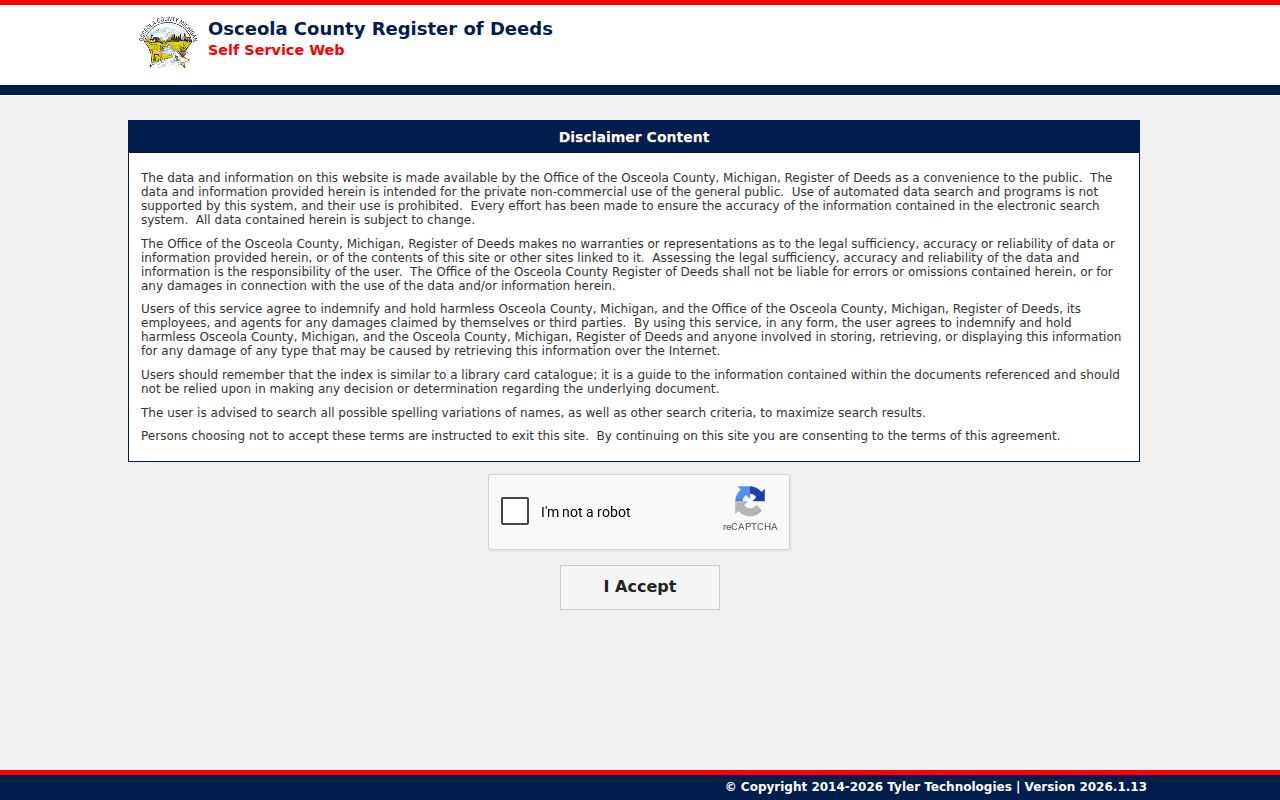
The gateway leads only to the index; the deed image, not the result row, carries the full recorded terms.
Match Osceola Legal Descriptions
An address is convenient, but the legal description is the durable land key. Osceola descriptions may use lot and block, a named subdivision, or section-township-range. Some also carry quarter-quarter calls or metes-and-bounds wording. The county spans R7W through R10W and T17N through T20N.
Copy wording exactly as recorded. Parcel numbers can change after a split, combination, replat, or boundary adjustment. The land description preserves links to prior instruments.
If legal-description mode returns nothing, try Liber/Page, party names, Plat/Condo search, and the office tract process. Staff research is not a title search.
Read Beyond the Osceola Deed
A deed is rarely the whole story. Mortgages draw assignments and discharges behind them. Easements and restrictions can hide inside a plat, a declaration, or a separate instrument.
Check every satisfaction and release on its own. A dismissed case or a paid-off loan does not wipe a filing by itself. Match the parties, the dates, and the legal description. Judgment liens and lis pendens deserve a cross-check between Tyler and the court file.
Tax foreclosure leaves a different trail. It runs through the Treasurer, state process, recorded notices, and a later deed. Delinquency alone never tells you the final owner.
Resolve Osceola Name Variants
Osceola indexes copy names straight from the filed instruments. Old handwriting and modern data entry both breed variants. Search a surname with and without the given name. Try initials, middle names, former surnames, and plausible spellings. For a company, keep the punctuation but also test the bare business name. A trust may appear under the trustee, the trust, or both.
Date limits keep broad searches usable. Start with the likely transfer window, then widen it. Type filters can sort deeds away from mortgages and releases. When you cannot tell which side a party sat on, search grantor and grantee both. An "Either Party" result helps discovery, but each candidate still needs a land match.
The legal description settles everything. Compare subdivision, lot, block, section, township, range, and metes-and-bounds text. A situs address may have changed, and postal city lines rarely match municipal ones. The land description and recorded references are the safer bridge.
Keep a short log. For each deed, jot the query and the exact indexed name. Add the instrument type, recording date, and Liber/Page or instrument number. Note the grantor, grantee, and description. A log stops circular searching and exposes a real gap that needs office help.
Understand Osceola Recording Dates
Signing, acknowledging, delivering, and recording can all fall on different days. Tyler's recording-date filter tracks only the office filing date. Read the instrument itself for execution details, then decide which date supports your conclusion.
A newer recording is not automatically a fresh sale. Corrective deeds and fiduciary conveyances need their own context. So do land contracts, tax deeds, and court-related instruments. Rank nothing by date alone until you have read the type. Consider the parties and the land too.
The Register keeps permanent custody and public access intact. Legal effect, missing interests, mineral rights, and insurability sit beyond the search service. Those questions may call for an attorney or a title professional.